Companies are adopting AI to cut workforce cost, but the rules keep a named person accountable for the output, and checking that output takes skilled people, time and documentation that most business cases leave out.
Executive Summary
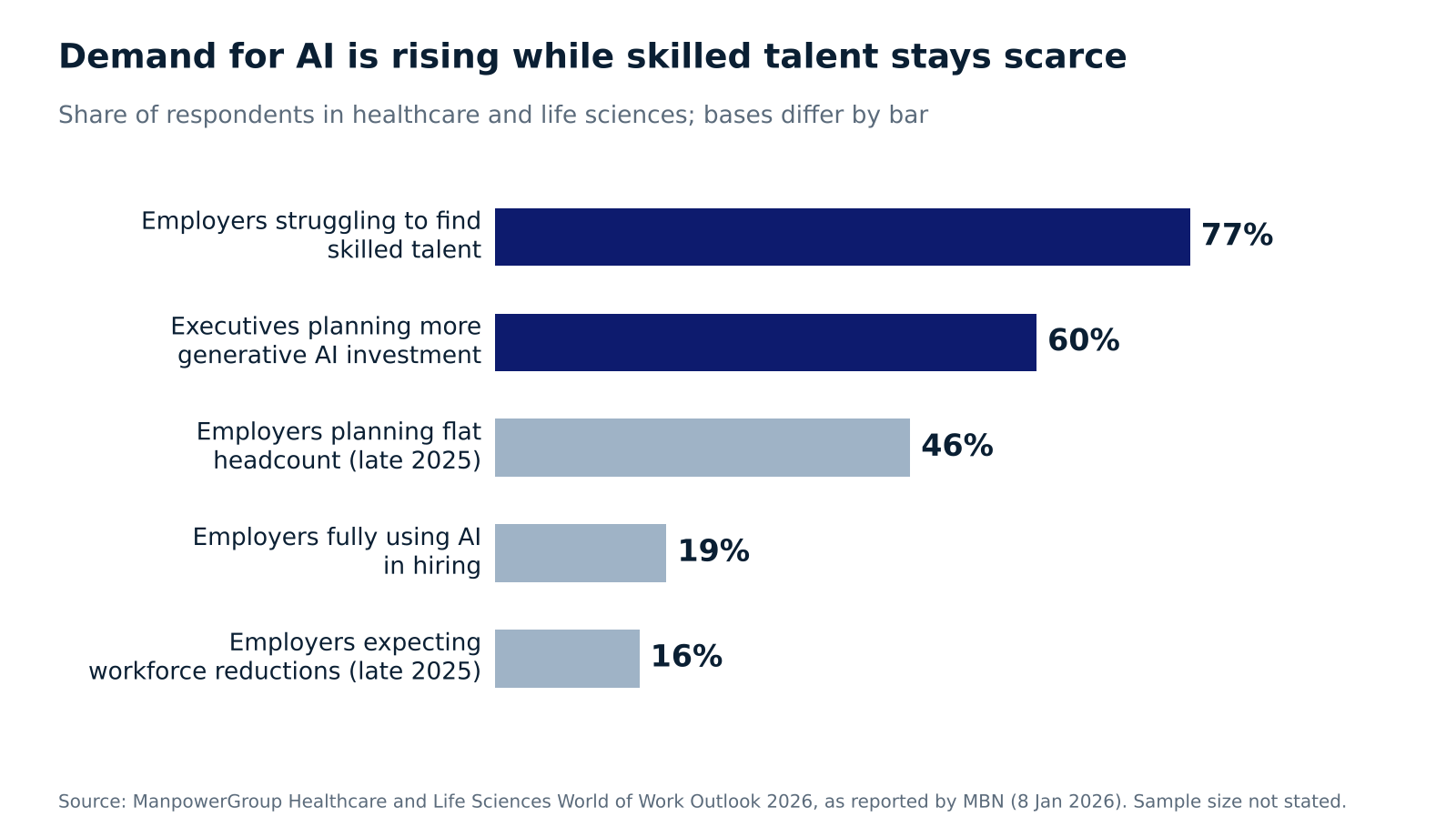
- Demand is rising and skills are short. 60% of life sciences executives plan to increase generative AI investment, and 77% of healthcare and life sciences employers struggle to find the skilled talent they need (ManpowerGroup, Jan 2026).
- Skills are weakest where the stakes are highest. In a vendor assessment of about 9,400 pharma employees, foundational generative AI readiness was 82%, but responsible AI use was 68% (Workera).
- The rules scale oversight to risk. The FDA's draft guidance, the EU AI Act and the CIOMS pharmacovigilance report all expect real human oversight, not a signature. None of them sets a headcount, so each company has to decide and defend its own.
- The business consequence. An AI cost saving is only real after the cost of validating the output is counted.
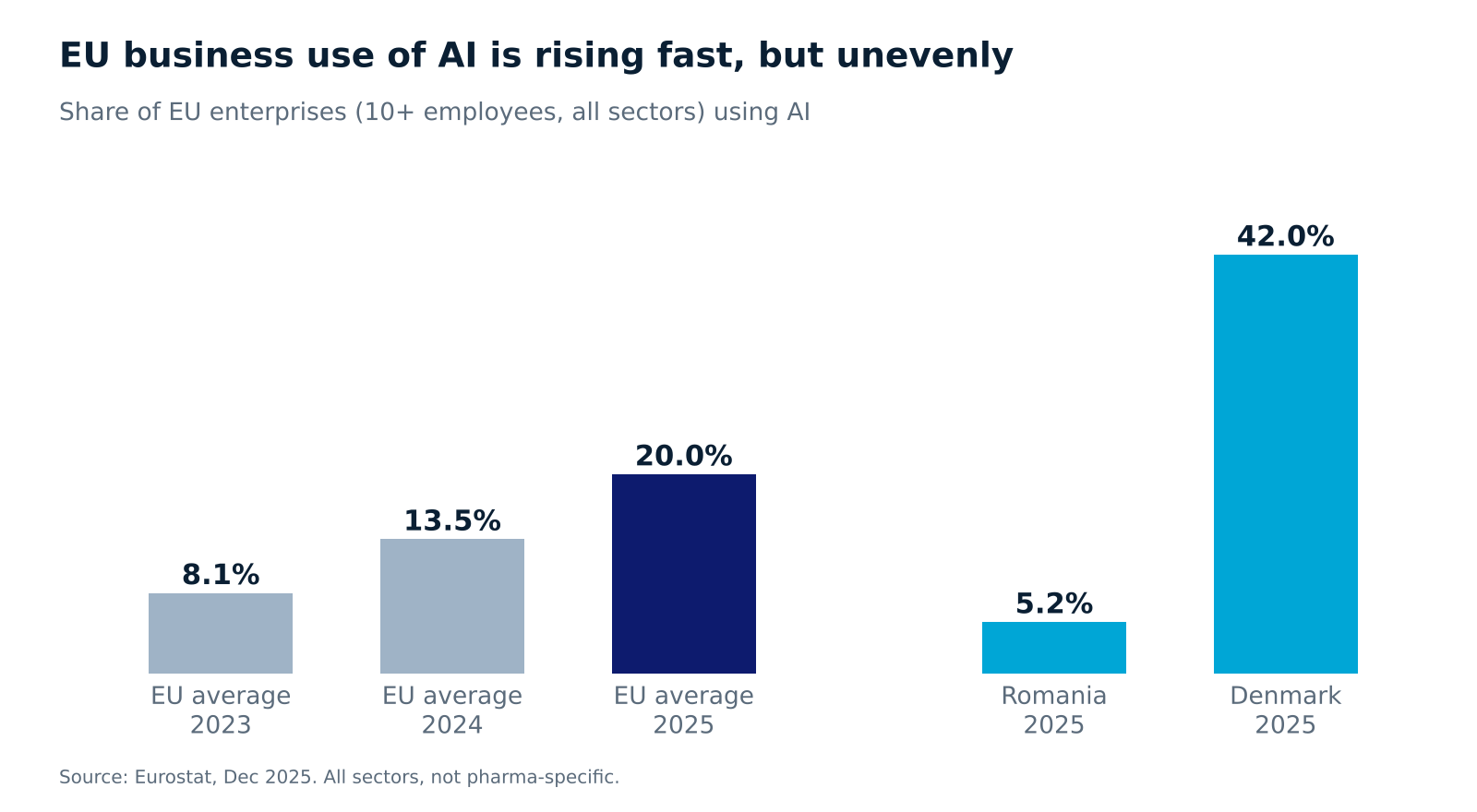
Regions differ. AI use is rising across the EU, but from 5.2% of enterprises in Romania to 42.0% in Denmark in 2025 (Eurostat).
Sustaining Industry Momentum
The pressure on the life science workforce in 2026 comes from cost, talent scarcity and the pull of AI at the same time.
The industry still produces breakthrough treatments, but the people behind them are being asked to do more with fewer resources. ManpowerGroup reports that 77% of healthcare and life sciences employers struggle to find skilled talent, while in late 2025 46% planned to keep headcount flat and 16% expected reductions (ManpowerGroup, via MBN, Jan 2026). The same report puts the patent cliff at US$236 billion between 2025 and 2030, which keeps cost under pressure.
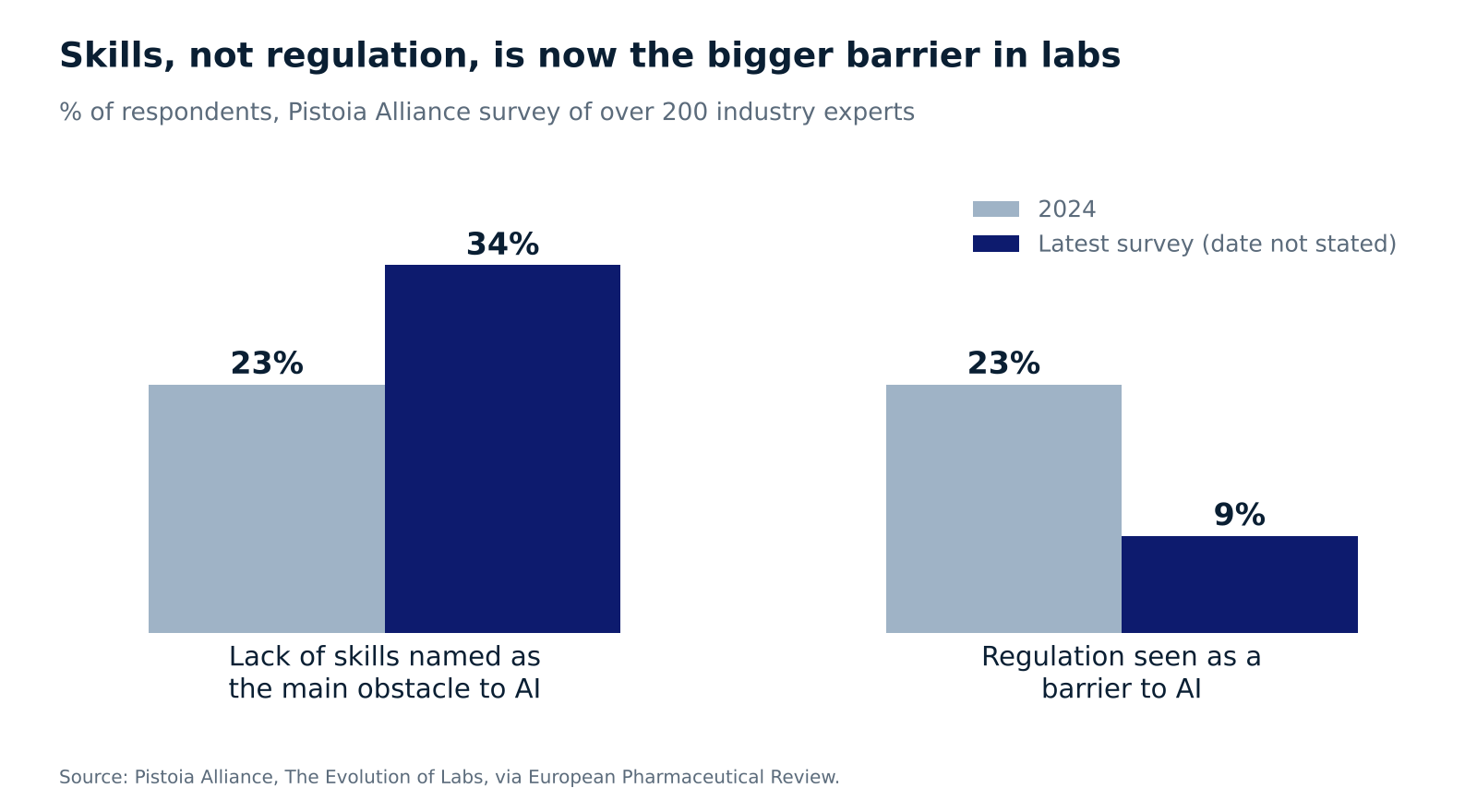
AI is the obvious response, and leaders know it. 60% of life sciences executives plan to increase generative AI investment across the value chain. In laboratories, more than 75% of respondents in a Pistoia Alliance survey of over 200 experts plan to adopt AI within two years, yet 34% named lack of skills as the main obstacle, up from 23% in 2024 (European Pharmaceutical Review).
The momentum is real. The open question for executives is how many skilled people the AI itself will need around it.
Value Proposition: Where Technology Meets the Workforce
The value of AI in a life science company depends on whether its people can use the tools and also challenge what the tools produce.
Digital skills are now a prerequisite for highly specialized workers, and that can be measured. In an assessment of about 9,400 pharma employees across commercial through R&D roles, readiness in foundational generative AI skills reached 82%, but readiness in responsible AI use was 68%, a 14-point gap (Workera). Employees are learning to use the tools faster than they are learning to judge them.
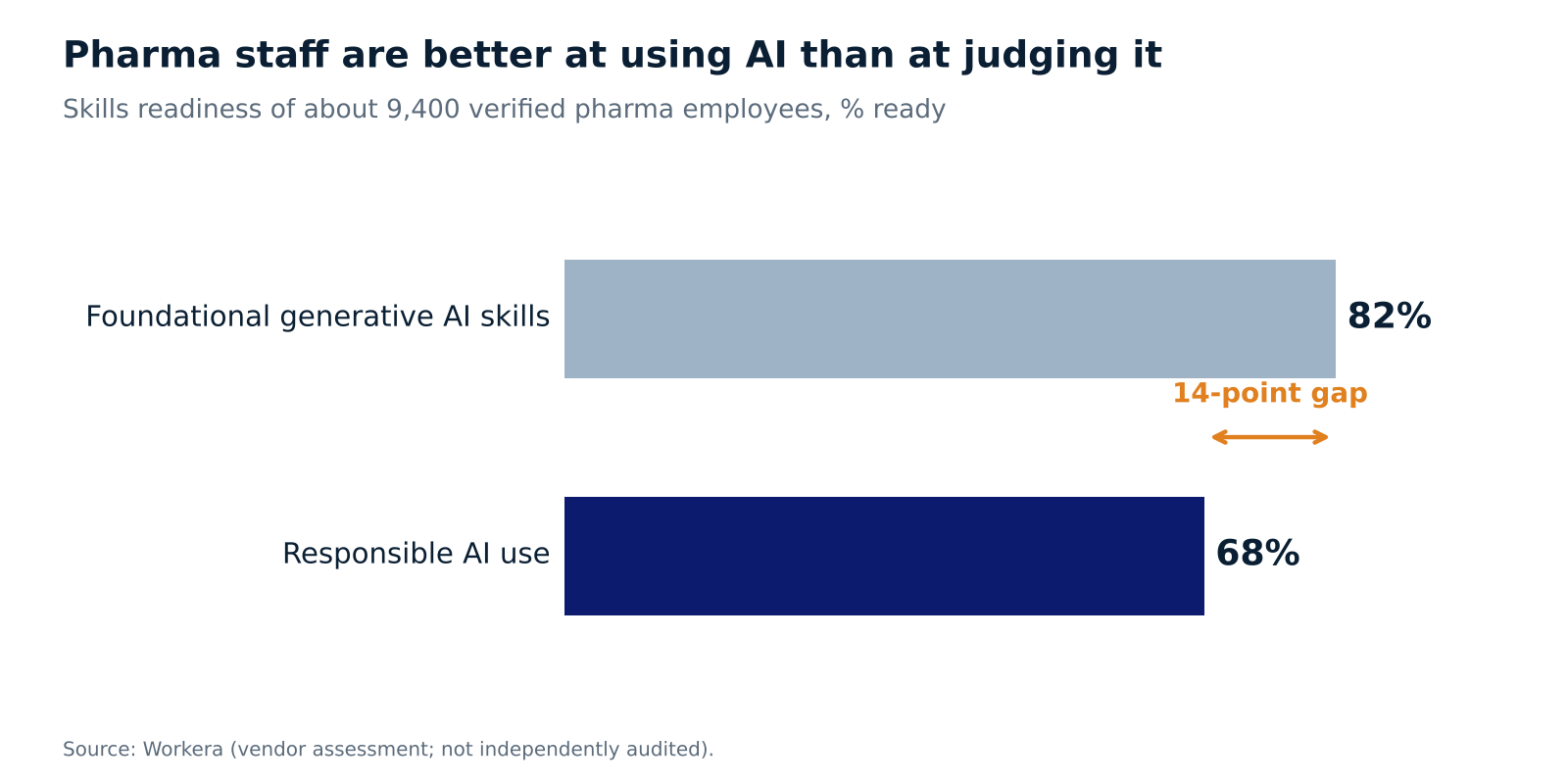
What these figures do and do not show. Workera reports that nearly 9,400 of more than 12,000 invited employees verified their skills, in programs running from commercial through R&D roles at pharmaceutical companies it does not name. Its article does not define "readiness" or break the results down by age, job role or technical background, so we cannot say whether the gap is wider among scientists, clinicians, data specialists or general staff. ManpowerGroup's 77% does not split the shortage by skill type or demographic either. The closest role-level evidence is a figure from the consultancy Eularis, cited by IntuitionLabs: about 70% of pharma hiring managers struggle to find candidates who combine pharmaceutical knowledge with AI skills. That points to a hybrid skill gap, but it is a secondary source and its survey date is not given there. None of the sources we opened breaks the figures down by age.
That gap is the value proposition for leadership. Using AI makes work faster. Judging AI keeps the work defensible. A workforce plan that pays for the first and not the second saves money in the short term and carries the risk in the long term.
Planning for Workforce Investment
A workforce plan for 2026 needs a budget line for validating AI output, alongside the lines for tools and training.
Good workforce planning already means preparing for labor-market variability, protecting psychological health and safety, and training the whole enterprise to use technology. Those points still hold. What changes in 2026 is that AI shifts work from producing outputs to reviewing them, and review needs people with the right skills and enough time.
| Budget line | What it pays for | Question for leadership |
|---|---|---|
| Tools and integration | AI software, data access, system validation | Is the tool qualified for its specific use? |
| Upskilling | Generative AI skills and responsible AI skills | Are reviewers trained to challenge output, not just use it? |
| Validation and oversight | Reviewer time, sampling, documentation, error-rate (accuracy) testing against reference standards, ongoing performance monitoring | How many outputs does each reviewer check, and how long do they get? |
| Governance | Named owners, escalation paths, audit records | Who can override the system without asking permission? |
Where AI replaces routine tasks, the people who remain are usually asked to take on the review. Planning for that early is cheaper than rebuilding the team after a finding.
A global view
This paper is not limited to the United States. The workforce base and the pace of AI adoption differ by region, and the European picture matters because EU rules on AI use shape how companies there must run AI-supported work.
| Region | Pharma workforce | AI adoption indicator |
|---|---|---|
| United States | 358,600 pharmaceutical manufacturing jobs in June 2026 (U.S. Bureau of Labor Statistics, as reported by Pharmuni) | No pharma-specific measure found in the sources reviewed |
| Europe (EFPIA area) | About 955,000 people directly employed in 2025 (estimate), including about 125,000 in R&D (EFPIA) | 20.0% of EU enterprises with 10 or more employees used AI in 2025, up from 13.5% in 2024 and 8.1% in 2023, across all sectors (Eurostat) |
The US figure counts manufacturing jobs only. The European figure counts direct employment across the industry in the wider European (EFPIA) area, not only EU member states. The Eurostat figure covers all sectors. We did not find a published measure of how much of the European pharma workforce uses or oversees AI, and that is the evidence gap this research aims to fill.
Europe: Investment Pressure and the AI Workforce
European life science companies are being asked to meet new AI rules while industry reports growing pressure on investment, and no source we found measures how that affects their AI workforce.
| Indicator | Figure | Source |
|---|---|---|
| Pharma R&D spending growth, 2010 to 2022 (average per year) | Europe 4.4%, US 5.5%, China 20.7% | EFPIA, Nov 2024 |
| Europe's share of global pharma R&D | 43% in 1990, now 31% and falling | Open letter from nine pharma chairs, 22 Sep 2026 (industry claim) |
| Europe's share of commercial clinical trials | Halved in a decade, to 9% | Same open letter (industry claim) |
| Venture capital invested, 2025 | Europe €66.2 billion, about 22% of the US amount | Lerner, Harvard, via CEPR VoxEU, Feb 2026 |
| Planned German investment cuts | Eli Lilly halving a €2.3 billion plan; Boehringer Ingelheim cutting €900 million for 2027 to 2030 | Fierce Pharma, citing Handelsblatt |
The German cuts are tied to pricing and policy, not to AI. Both companies cite a planned healthcare reform that would reduce costs and discount branded medicines, and Boehringer cites a lack of investment predictability. German press reports say the federal government is defending its course (onvista). The open letter asks governments for faster clinical trial approvals and fiscal flexibility to invest in health and innovative medicines.
Meanwhile the rules keep coming. EU AI literacy obligations have applied since 2 February 2025 and national enforcement began on 2 August 2026, and the oversight duties for high-risk systems require trained people with authority to override the system (see AI, Accountability and the Cost of Validation).
Two things are not known from the sources reviewed: how much pharma companies in each European country are investing in AI, and what share of the European pharma workforce uses or oversees AI. The first is a funding question and the second is a workforce question. Both bear on whether European companies can afford the validation capacity the rules describe, and both are open for further research.
Looking Ahead: 2026 to 2030
The sources we opened all point the same way by 2030: more AI use, more skills pressure and more rules.
| Signal | Figure | Source |
|---|---|---|
| EU enterprises using AI | 8.1% (2023), 13.5% (2024), 20.0% (2025) | Eurostat |
| EU's own 2024 projection for 2030 | 17% of companies using AI, already passed in 2025 | Second Report on the Digital Decade, via The Stack |
| EU Digital Decade target for 2030 | 75% of companies using cloud, big data or AI (combined measure) | Eurostat |
| Lab AI adoption plans | More than 75% of surveyed experts plan to adopt AI within two years | European Pharmaceutical Review |
| Generative AI investment | 60% of life sciences executives plan to increase it | ManpowerGroup, via MBN |
| Patent cliff, 2025 to 2030 | US$236 billion | ManpowerGroup, via MBN |
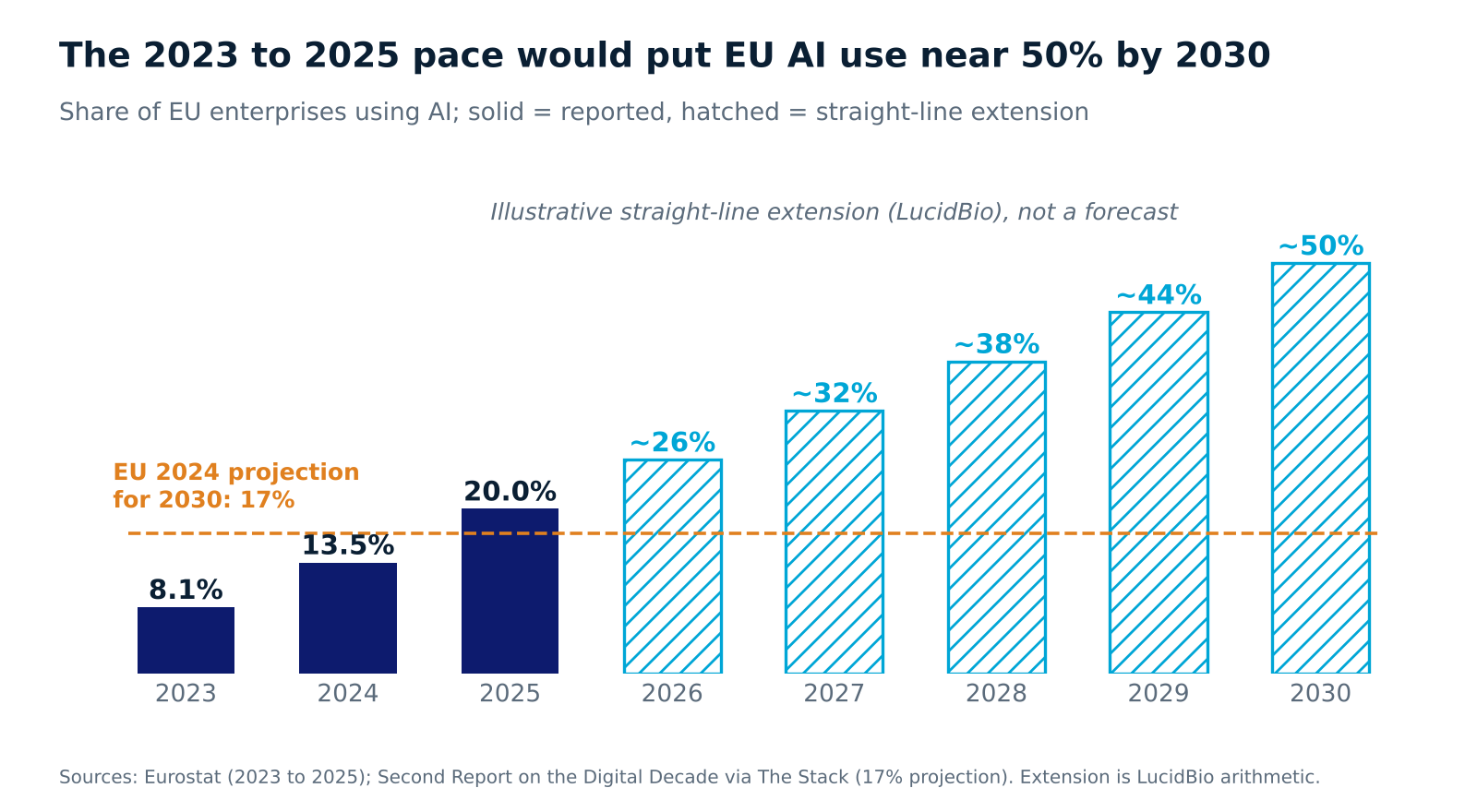
The hatched bars extend the Eurostat trend in a straight line, about 6 points a year. This is LucidBio arithmetic to show direction, not a forecast: real adoption could be faster or slower, and the figures cover all sectors, not pharma.
What cannot be projected from these sources is how many reviewers AI output will need or what validation will cost. No source gives either figure, so we have not modeled them.
AI, Accountability and the Cost of Validation
The FDA, the EU and the pharmacovigilance community all expect a human to stay accountable for AI output, and none of them says how many people or hours that takes.
| Source | What it expects of people | Status |
|---|---|---|
| FDA draft guidance on AI for regulatory decision-making (Jan 2025) | The sponsor defines the question, the model's role and the risk if it is wrong, then validates in proportion. A model that decides without human review is higher risk. Human review lowers risk only if it is documented and the model is monitored for drift. | Draft, non-binding |
| EU AI Act, Articles 14 and 26 (high-risk systems) | Deployers assign oversight to people with competence, training and authority. Overseers must be able to override or stop the system without asking permission, and must watch for over-reliance on its output. | High-risk application dates adjusted under the Digital Omnibus |
| EU AI Act, Article 4 (AI literacy) | Providers and deployers take measures to build AI literacy in staff who use AI. No certificate is required. | Applies since 2 Feb 2025; national enforcement from 2 Aug 2026 |
| CIOMS report on AI in pharmacovigilance | Risk-based oversight scaled to the potential impact of errors on patient safety, using human in the loop, human on the loop or human in command. Validation against reference standards, continuous performance monitoring, and assigned roles across the AI lifecycle. | Report published 4 Dec 2025; summary reflects the draft |
Where the line is and where it is not
Two things are clear from these sources. AI output with patient or regulatory impact is not meant to run without human oversight, and oversight that cannot question or override the system is not meant to count. A person who signs off without the time, training or authority to disagree is oversight in name only.
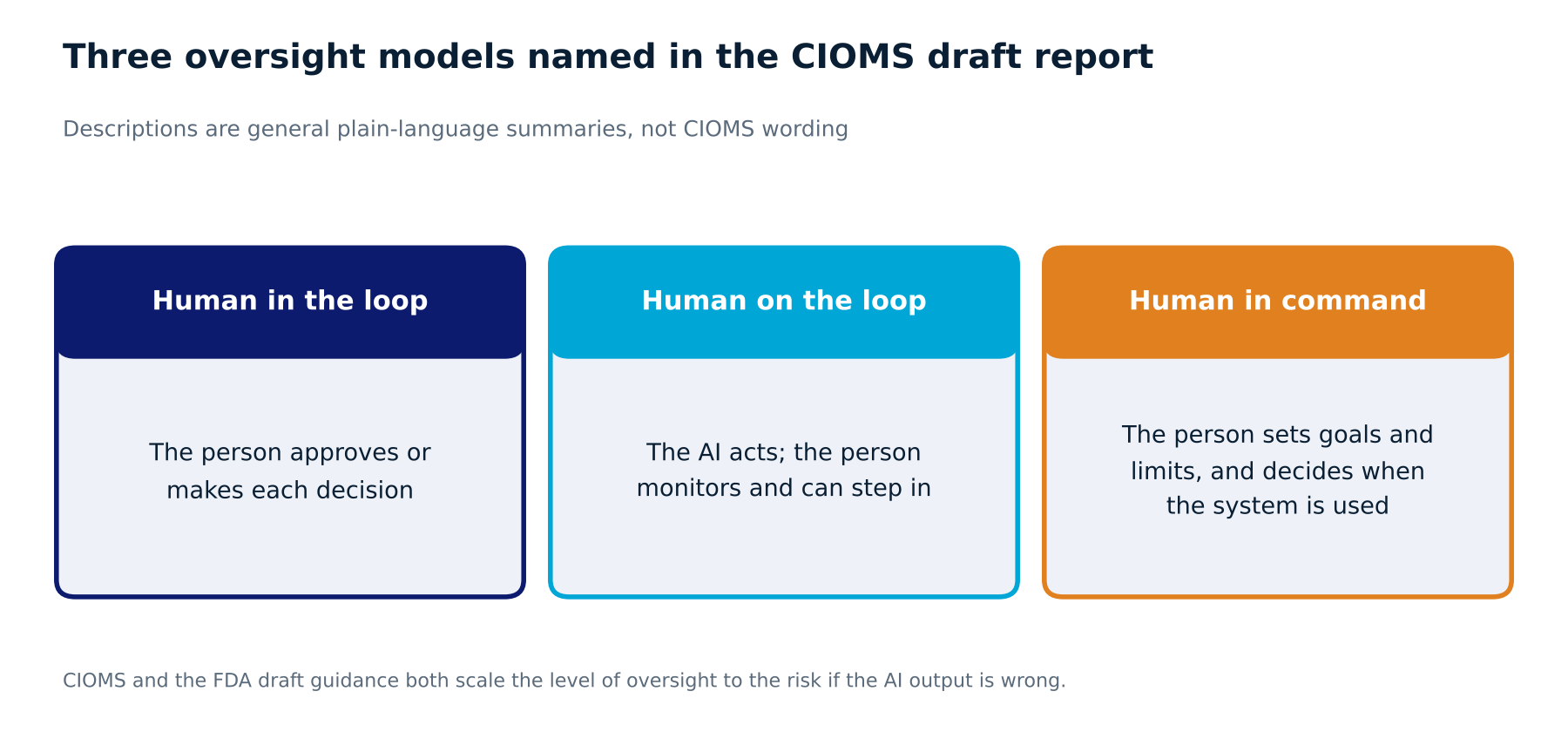
One thing is not clear: how much review is enough. No source sets a number of reviewers, a share of outputs to check or a review time. That is the gray zone, and each company is left to decide and defend its choice. In a 2026 pharmacovigilance survey from vendor iVigee, 56% of respondents were experimenting with or applying AI, 6% said AI was fully reshaping their operations, and the largest frustration was resource constraints (31%) (iVigee). The survey's sample size and dates are not disclosed.
What this does to the cost case
An AI business case that counts only the saving from fewer hours of production work is incomplete. The oversight the rules describe adds four costs:
- Reviewer capacity. People with enough time to check output, not only to approve it.
- Reviewer skill. Training in responsible AI use, where the Workera data shows the weakest readiness (68%).
- Documentation. Records that show what was checked, by whom and what was changed.
- Monitoring. Ongoing checks for drift and for error rates (accuracy), with a way to revalidate when performance changes.
The net saving is the AI saving minus these four. For some functions it is still large. For others it is small or negative, and leadership should know which before cutting the team.
Note: this section is LucidBio's reading of the sources above, which are summaries by law firms, consultancies and vendors. Readers should consult the original texts for legal purposes.
Shaping Disruption into Opportunity
Companies that build the ability to validate AI will be able to use it faster and with fewer surprises than those that treat validation as an afterthought.
Technology can create jobs and give companies a chance to partner with their workforce. For AI, the specific opportunity is validation. Validation is a capability, and a company that has it can deploy AI into higher-value work because it can show regulators, auditors and partners how the output is checked.
There is some sign that the industry is moving this way. In the Pistoia Alliance lab survey, only 9% saw regulation as a barrier to AI, down from 23% in 2024, while 34% named lack of skills as the main obstacle (European Pharmaceutical Review). Read together, regulation is seen as manageable, and people with the right skills are what is missing.
Roles that become more important in this model include:
- Reviewers with authority to question and override AI output.
- Validation and quality leads who define the context of use and the acceptance criteria.
- Regulatory and medical writers who can document how AI-supported work was checked.
These are LucidBio's expectations from the rules above, not measured hiring trends.
What Leaders Should Do Next
Before reducing headcount because of AI, leaders should be able to answer five questions in writing.
- What decision does this AI output inform, and what happens if it is wrong? This sets the level of oversight.
- Who reviews it, and do they have the time, training and authority to disagree? A signature alone does not count.
- What share of outputs is checked, and how often are they changed? A review that never changes anything needs a closer look.
- How is performance monitored after launch? Models drift, and someone must own revalidation.
- What does validation cost, and is it in the business case? Net the saving against it.
LucidBio helps teams build the cost-efficiency and regulatory compliance framework behind these answers. We start from industry intelligence and regulatory requirements, align processes with compliance standards, and recommend training for the people who review AI output. Where a company needs help carrying the changes through, we work alongside a transformation consultant. A first step is a short readiness review of one function, such as safety, regulatory writing or data analysis, that sets out its oversight model and its real net cost.
Sources and Data Notes
This 2026 edition replaces the 2021 figures with sourced 2026 data where it could be found. Sources were checked on 12 November 2026.
What changed from the 2021 edition
| 2021 item | 2026 treatment |
|---|---|
| 55% transforming value chain, 34% workforce | Not repeated; source not named in the 2021 edition |
| BLS employment and women's workforce decline (2018 to 2020) | Replaced with a June 2026 US figure and European figures (see Planning for Workforce Investment) |
| 42% of Americans working from home | Not repeated; figure from the 2021 edition |
| Technology, agile and digital skills themes | Kept and updated with 2026 skills data |
| AI accountability and validation cost | New section |
Sources opened
- ManpowerGroup Healthcare and Life Sciences World of Work Outlook 2026, as reported by MBN (8 Jan 2026). Survey sample size and dates are not stated in the article.
- Workera, Pharma's AI skills (vendor marketing; not independently audited)
- European Pharmaceutical Review on the Pistoia Alliance Evolution of Labs survey. Survey date not stated.
- iVigee, AI in pharmacovigilance (vendor article; sample size not disclosed)
- Eurostat, 20% of EU enterprises use AI technologies (Dec 2025)
- EFPIA, The Pharmaceutical Industry in Figures 2026
- EFPIA, R&D spending in Europe outpaced by the US (13 Nov 2024)
- Open letter from nine pharma chairs, Europe losing the pharma investment race (22 Sep 2026). Industry advocacy; claims are the signatories' own.
- Fierce Pharma, Lilly and Boehringer plan to cut German investment, citing Handelsblatt
- onvista, German pharma investment cuts and the federal government's response (June 2026). Headline only was reviewed.
- Lerner, The venture capital challenge for Europe, CEPR VoxEU (20 Feb 2026)
- Pharmuni, US pharma employment, citing the U.S. Bureau of Labor Statistics (secondary source)
- IntuitionLabs summary of the FDA January 2025 draft guidance
- Sidley summary of the CIOMS draft report on AI in pharmacovigilance
- European Commission AI literacy Q&A
- EUAIAct.com on human oversight
- IntuitionLabs, Pharma's AI skills gap (secondary source citing Eularis; survey date not given there)
- Eurostat, Digitalisation in Europe 2026 (Digital Decade 2030 target)
- The Stack, on the Second Report on the Digital Decade (secondary source; published July 2024)
Several sources are summaries by law firms, consultancies and vendors, not the original texts. Readers should consult the original texts for legal purposes.